
Research & Development
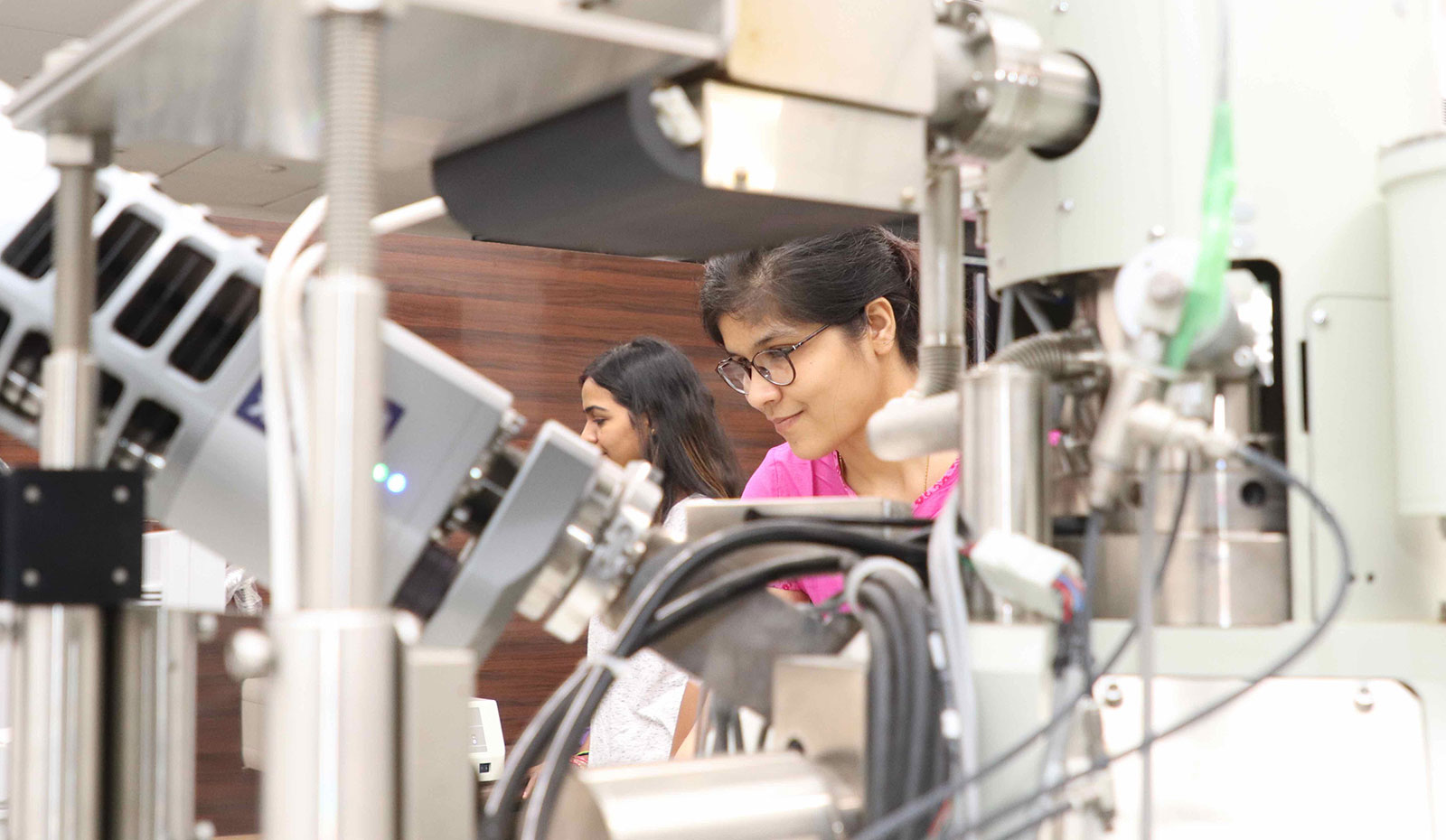
As a hub for cutting-edge research, IITGN is fostering interdisciplinary collaborations to address critical challenges in science, technology, design, and society. Through partnerships with leading global institutions and industries, the institute drives advancements in energy, healthcare, artificial intelligence, sustainability, and materials science. With world-class research facilities, a strong emphasis on translational impact, and a flexible academic structure, IITGN provides an environment that supports innovation, industry collaboration, and international research engagement.
Research SpectraIIT Gandhinagar aspires to promote world-class research that will make a positive impact on society today and groom the leaders and creators of tomorrow’s technologies.
The Institute is also fostering ties with various institutes in India and abroad, which enables IITGN undergraduate students pursue short term research stints during the summer. Our Summer Research Internship Programme (SRIP) has become flagship program among students with a selectivity of about 1 in 100 applications.
View Research Facilities Library
Highlights
-
Secretary Hillary Rodham Clinton, former First Lady and Secretary of State of the US, visits IIT Gandhinagar
Moreflip_to_front
Secretary Hillary Rodham Clinton, former First Lady and Secretary of State of the US, visits IIT Gandhinagar
Share -
IITGN Hosts Tahesha Way, Lt. Governor of New Jersey:
Moreflip_to_front
IITGN Hosts Tahesha Way, Lt. Governor of New Jersey:
Share -
Indo-Thailand Workshop on AI-Driven Innovations (AIDI)
Moreflip_to_front
Indo-Thailand Workshop on AI-Driven Innovations (AIDI)
Share -
Strengthening Academic and Industrial Collaborations with Taiwan
Moreflip_to_front
Strengthening Academic and Industrial Collaborations with Taiwan
Share -
Towards A New Era: Launch of GIFT International Fintech Institute
Moreflip_to_front
Towards A New Era: Launch of GIFT International Fintech Institute
Share -
‘Japan Meets India’ Summit to Foster Collaboration in Research and Education
Moreflip_to_front
‘Japan Meets India’ Summit to Foster Collaboration in Research and Education
Share
Research@IITGN
-
-
-
-
-
Unusual Rainfall in Gujarat Sparks Concerns Over Urban Flooding and Infrastructure Resilience
Link
Research Capsules
-
Precision Monitoring For Next-Generation Ultrasound Therapies
Moreflip_to_frontPrecision Monitoring For Next-Generation Ultrasound Therapies
Modern therapeutic interventions thrive on precision, and precision begins with effective monitoring. Therapies such as histotripsy and ultrasound-mediated drug delivery harness a phenomenon called cavitation, which involves the formation and collapse of microscopic bubbles in response to ultrasound exposure inside the body. These bubbles can mechanically break down targeted tissue, including cancer cells, non-invasively and enhance drug delivery by temporarily increasing cell membrane permeability. Yet accurately tracking this bubble activity in real time remains a major challenge, limiting clinicians’ ability to monitor therapy and confirm treatment outcomes.
Find Out More
Read the story on facebook.
Read the story on instagram.
Read the story on X.
Read the story on linkedin.Share favorite_border -
Keeping 3D Printing on Track with Al
Moreflip_to_frontKeeping 3D Printing on Track with Al
The most dangerous manufacturing crises are the ones that develop silently. As 3D printing moves beyond hobbyist spaces into research and industrial applications, early fault detection is critical to preventing these failures before they escalate. Nozzle clogging is a common and critical problem that weakens parts, distorts dimensions, and ruins prints after hours of work. Conventional detection methods designed for filament-based printers don’t work well for the newer pellet-based 3D printers, where material flow is more complex.
Find Out More
Read the story on facebook.
Read the story on instagram.
Read the story on X.
Read the story on linkedin.Share favorite_border -
Turning Clay into a Nano-Control System
Moreflip_to_frontTurning Clay into a Nano-Control System
From cellular processes in the human body, to emerging technologies like sensors and lab-on-a-chip devices, the movement of ions (charged particles like sodium and potassium) in water plays a critical role in their functioning. Scientists have long known that electric fields can be used to control ion flow, but only in low-salt conditions. In real-world systems like seawater, blood, or industrial wastewater, high salt concentrations usually cancel out electrical control, making precise regulation extremely difficult.
Find Out More
Read the story on facebook.
Read the story on instagram.
Read the story on X.
Read the story on linkedin.Share favorite_border -
Lighting the Way Against Antimicrobial Resistance
Moreflip_to_frontLighting the Way Against Antimicrobial Resistance
If antimicrobial resistance (AMR) were a criminal, it would certainly make the world’s ‘most wanted’ list. Scientists are currently trying to forge the right weapon to defeat one of its major contributors: biofilms. These slimy layers are essentially communities of microorganisms that provide a safe space to grow and shield themselves from antibiotics, disinfectants, and even the immune system, thereby accelerating the rise of AMR.
Find Out More
Read the story on facebook.
Read the story on instagram.
Read the story on X.
Read the story on linkedin.Share favorite_border -
Redesigning Learning Spaces in MOOCs
Moreflip_to_frontRedesigning Learning Spaces in MOOCs
During the COVID-19 pandemic, Massive Open Online Courses (MOOCs) rapidly emerged as a vital platform for accessing education and building skills when traditional learning was disrupted. Discussion forums (DF) usually play an important role in bridging the gap between the instructor and learners, by building a community that enables interaction, problem solving, and better understanding. Despite its advantages, students’ low engagement still remains a challenge.
Find Out More
Read the story on facebook.
Read the story on instagram.
Read the story on X.
Read the story on linkedin.Share favorite_border
Research Snips
-
India's Water Paradox
Moreflip_to_front
India's Water Paradox
India is caught in this heartbreaking water paradox. From 1980 to 2021, the Indus and the Ganga tell very different stories. More rainfall raised the Indus’ flow by about 8%, but the Ganga shrank by almost 17%. A study from IIT Gandhinagar shows that the core issue isn’t rising heat, but how we manage or mismanage our water. Groundwater and surface water function as a single, connected system. Intensive pumping, combined with weakening monsoon rainfall, has disturbed this balance. The Ganga now increasingly loses water to aquifers instead of being sustained by them, underscoring the urgent need for integrated, climate-resilient water management.
Find Out More
Read the story on facebook.
Read the story on instagram.
Read the story on twitter.
Read the story on linkedin.Share favorite_border -
Sounding the fight against antibiotic resistance
Moreflip_to_front
Sounding the fight against antibiotic resistance
We’ve all heard about antibiotic resistance — a major health challenge of our time. At IIT Gandhinagar, researchers took a step to address the problem of localised bacterial infections. Instead of relying on pills or light, they turned to ultrasound, the same sound waves used in medical scans. In lab experiments with E. coli, when ultrasound was paired with a BODIPY (sonosensitizer) and tiny microbubbles, the bacterial count dropped by more than 99.9%, making those sound waves a weapon against bacteria. It’s a striking idea: using sound as an alternative approach when bacteria become drug resistant, especially when infections are localised. This approach could open new possibilities for tackling infections that hide deep in the body or that resist traditional antibiotics.
Find Out More
Read the story on facebook.
Read the story on instagram.
Read the story on twitter.
Read the story on linkedin.Share favorite_border -
Getting to Black Holes Faster: Efficient Estimation of Black Hole Parameters
Moreflip_to_front
Getting to Black Holes Faster: Efficient Estimation of Black Hole Parameters
Ten years from now, three spacecraft will be launched into orbit around the sun, approximately 50 million kilometres from Earth, to detect ripples in the spacetime called gravitational waves (GWs). This detector is named Laser Interferometer Space Antenna (LISA), and has an arm length of 2.5 million kilometres between its spacecraft, a million times larger than the terrestrial LIGO observatory, enabling the detection of GWs in milli-Hertz band. LISA will detect GWs from supermassive black hole binaries. The authors propose the use of a meshfree method in accelerating the parameter estimation of such sources.
Find Out More
Read the story on facebook.
Read the story on instagram.
Read the story on twitter.
Read the story on linkedin.Share favorite_border -
Cues to Move: Parkinson’s Patients Perception of Physical Stimulation
Moreflip_to_front
Cues to Move: Parkinson’s Patients Perception of Physical Stimulation
Freezing of gait is a common symptom of Parkinson’s disease, where patients briefly lose the ability to move forward while walking. Vibrations of small frequency on the skin at various locations, or vibrotactile stimulation, have been shown to help overcome this freezing. Studying Parkinson’s patients alongside healthy individuals, the authors compare how accurately these groups perceive vibrotactile input at various locations such as ‘Thigh’, ‘Finger’, ‘Wrist’ etc. They find that ‘Thigh’ is the best location for vibrotactile input, followed by ‘Wrist’, in Parkinson’s patients.
Find Out More
Read the story on facebook.
Read the story on instagram.
Read the story on twitter.
Read the story on linkedin.Share favorite_border -
Sugar that Heals: Chitosan-based Hydrogels that Self-Heal
Moreflip_to_front
Sugar that Heals: Chitosan-based Hydrogels that Self-Heal
A sugar found in the outer skeletons of shellfish, Chitosan, offers durability to materials called hydrogels - three-dimensional networks of polymers in water used in biological and medicinal contexts. Conducting a review on chitosan-based hydrogels, the authors highlight the various methods to synthesise these hydrogels. They outline how characterization of these hydrogels is carried out, for important physical properties such as injectibility and recoverability, and biological properties such as drug delivery, viability, and compatibility.
Find Out More
Read the story on facebook.
Read the story on instagram.
Read the story on twitter.
Read the story on linkedin.Share favorite_border
Postdoc Times
-
Battling Superbugs by Breathing New Life into Old Drugs
Moreflip_to_front
Battling Superbugs by Breathing New Life into Old Drugs
In the battle against bacteria, scientists are constantly searching for new weapons. However, developing brand-new drugs is time-consuming and expensive. Taking a different approach, Dr Rinku Choubey and Dr Moumita Chatterjee, have enhanced an existing medication by pairing it with a specialised molecule. This tag-team approach involves acetazolamide (AZM) and octaarginine (R8). By adjusting the ratio of these molecules and testing them against E. coli, the researchers found the combo to be an effective antibacterial!
Find Out More
Read the story on facebook.
Read the story on instagram.
Read the story on twitter.
Read the story on linkedin.Share favorite_border -
Blink and Miss: A Dilemma of Nanoscale Light Emitters
Moreflip_to_front
Blink and Miss: A Dilemma of Nanoscale Light Emitters
Perovskite Nanocrystals (PNCs) hold immense promise for next-gen technology, from ultra-efficient displays to quantum computing. However, a persistent challenge—Photoluminescence blinking—disrupts their performance by causing intermittent light emission. At IITGN’s NanoPlasmonics Research Lab, Dr NVS Praneeth, a Research Associate, is tackling this issue by developing protective coatings for Perovskite and QDs. The cross-institute research study aims to enhance the reliability of advanced QD and PNC-based technologies, paving the way for brighter displays, high-precision bioimaging, quantum encryption, and efficient solar cells.
Find Out More
Read the story on facebook.
Read the story on instagram.
Read the story on twitter.
Read the story on linkedin.Share favorite_border -
Nature’s QR Code: How DNA Barcoding Deciphers Plant Identity
Moreflip_to_front
Nature’s QR Code: How DNA Barcoding Deciphers Plant Identity
Nature is full of lookalikes—plants that appear nearly identical but may belong to entirely different species. This similarity can lead to major challenges for scientists, especially in medicine, agriculture, and conservation. Dr Nilesh Gawande, a postdoctoral fellow at IITGN, is part of a project that is using DNA barcoding for species identification with genetic precision. In a research study with multi-institute contributions, researchers analysed the matK gene and found it to be a robust marker that can differentiate even the most minor variations within closely related plant species.
Find Out More
Read the story on facebook.
Read the story on instagram.
Read the story on twitter.
Read the story on linkedin.Share favorite_border -
Time Travel Through Teeth?
Moreflip_to_front
Time Travel Through Teeth?
How did the Harappan civilisation sustain their cities, feed their livestock, and adapt to environmental challenges? Dr Manisha Kesarwani from the Interspecies Research Network (IRN-IITGN) of IITGN is part of a multi-institute, interdisciplinary study that is attempting to answer these questions by analysing the teeth of ancient domesticated animals. Using isotopic techniques, the team aims to uncover how Harappan communities residing in the ancient city of Dholavira, responded to climate shifts and seasonal changes.
Find Out More
Read the story on facebook.
Read the story on instagram.
Read the story on twitter.
Read the story on linkedin.Share favorite_border -
Infinite Sums, Precise Outcomes: Exploring New Arithmetic Terrai
Moreflip_to_front
Infinite Sums, Precise Outcomes: Exploring New Arithmetic Terrai
Mathematics can feel like solving a giant puzzle, where numbers hide fascinating secrets. At IITGN, Dr Shashank Ashok Chorge is uncovering some of these secrets using a tool called the Voronoi summation formula. Mathematicians use this formula to improve the “error terms,” which are minor inaccuracies that appear whilst estimating complex problems. The research also assessed how certain sums (called Riesz-type weighted sums) change their "sign" over time—shifting from positive to negative. These shifts are connected to a famous mathematics puzzle about the zeta function's zeros.
Find Out More
Read the story on facebook.
Read the story on instagram.
Read the story on twitter.
Read the story on linkedin.Share favorite_border
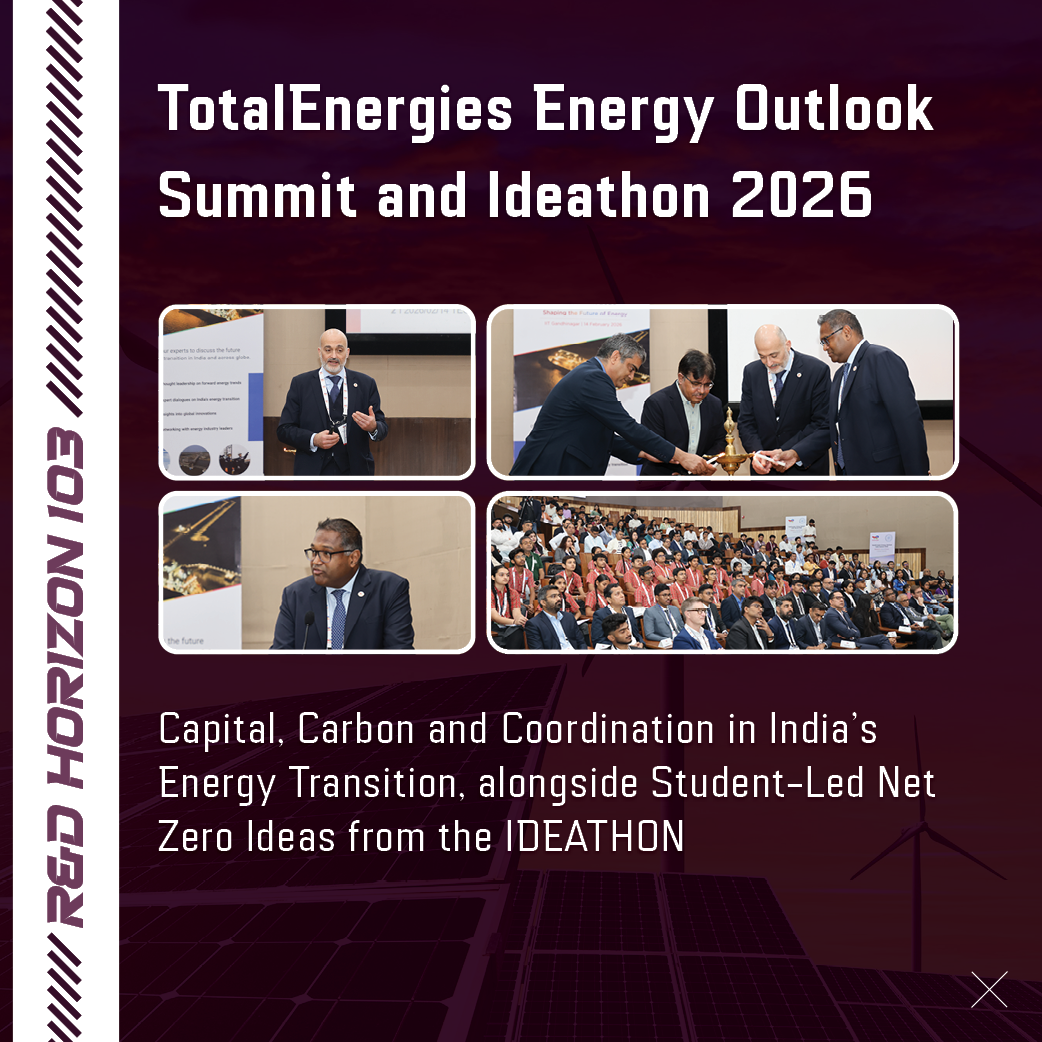
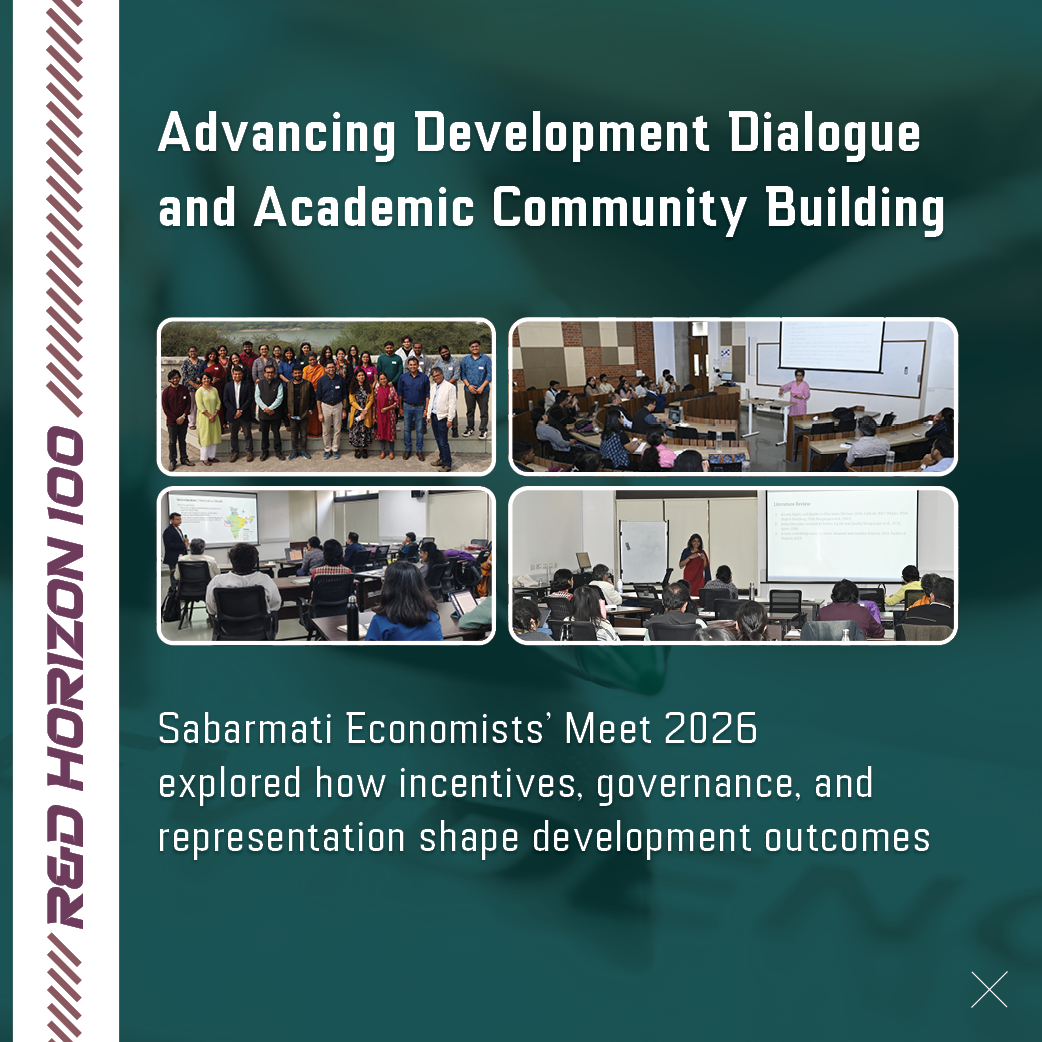
R&D Horizons
-
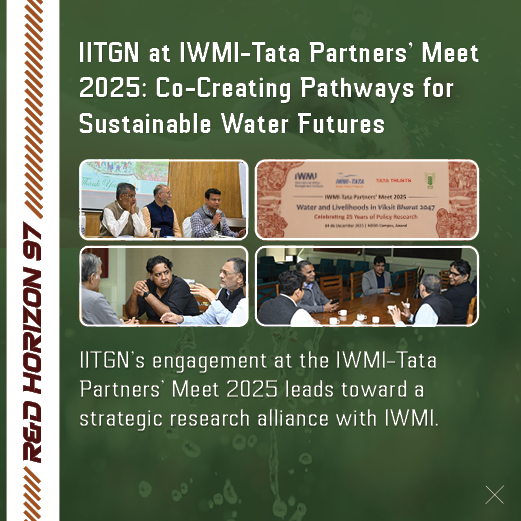
IITGN at IWMI-Tata Partners' Meet 2025: Co-Creating Pathways for Sustainable Water Futures
Moreflip_to_frontIITGN at IWMI-Tata Partners' Meet 2025: Co-Creating Pathways for Sustainable Water Futures
IITGN was invited to the IWMI-Tata Partners’ Meet 2025, held at the National Dairy Development Board (NDDB) Campus in Anand from December 4 to 6, 2025. This flagship event is an initiative of the IWMI-Tata Water Policy Program, created by the International Water Management Institute and Tata Trusts, to share ongoing work, receive feedback, and identify promising opportunities for collaborative application oriented water policy research.
Find Out More
Read the story on facebook.
Read the story on instagram.
Read the story on linkedin.
Read the story on X.Share favorite_border -
Advancing Data Science Through Immersive Learning
Moreflip_to_frontAdvancing Data Science Through Immersive Learning
IITGN-X, the Education Outreach Program of IITGN, held an enriching seven-day on-campus residency for its Data Science for Decision Making (DSDM) Batch 1 cohort. With a vision to facilitate professional development, the residency was designed to blend academics with industry engagement, providing exposure for DSDM Executive Masters students to cutting-edge technologies.
Find Out More
Read the story on facebook.
Read the story on instagram.
Read the story on linkedin.
Read the story on X.Share favorite_border -
Innovate, Pitch, Transform: IITGN Hosts Boeing BUILD Bootcamp
Moreflip_to_frontInnovate, Pitch, Transform: IITGN Hosts Boeing BUILD Bootcamp
"Entrepreneurship thrives when innovation is nurtured, and at IIEC, we empower changemakers to bring their visions to life,” says Mr Anand Pandey, Manager at the IITGN Innovation and Entrepreneurship Center.
With a strong commitment to fostering entrepreneurial talent, the Innovation and Entrepreneurship Centre (IIEC) at IITGN, in collaboration with Boeing, successfully hosted the Regional Bootcamp of the fifth edition of the Boeing University Innovation Leadership Development (BUILD) programme. This initiative plays a pivotal role in cultivating a dynamic student-to-start-up ecosystem, equipping young innovators with the resources, mentorship, and platform they need to transform ideas into meaningful solutions.
This year, the programme received an overwhelming response, attracting 116 applications from aspiring entrepreneurs across diverse disciplines. Following a rigorous selection process, 14 teams progressed to an intensive regional bootcamp held from 6th to 8th February 2025, where they refined their concepts through expert guidance and hands-on training. The journey culminated in the Regional Final on 9th February, where teams pitched their innovations before industry leaders.
By bridging the gap between ideation and execution, BUILD continues to ignite the entrepreneurial spirit, empowering innovators with the skills and confidence to drive change in India and beyond.
hashtag#Entrepreneurship hashtag#Innovation hashtag#BUILD2025 hashtag#IITGN hashtag#CCS hashtag#CarbonCapture hashtag#Sustainability hashtag#IITGN hashtag#IITGNRnDHorizon"
Find Out More
Read the story on facebook.
Read the story on instagram.
Read the story on twitter.
Read the story on linkedin.Share favorite_border -
Post-colab 2025
Moreflip_to_frontPost-colab 2025
"Academia and industry are natural partners, each bringing unique strengths to the table to create a brighter, more sustainable future, where the intellectual rigour of academia seamlessly merges with the practical ingenuity of industry,"" says Prof Soumyadip Sett, faculty-in-charge of Industry Connections, IITGN.
IITGN hosted the second edition of CoLab, its annual Industry Open House, on 22 February 2025, bringing together over 200+ industry leaders to foster cutting-edge collaborations between academia and industry. The event served as a dynamic platform for knowledge exchange, featuring thought-provoking discussions across ten key domains, including AI, Quantum Technologies, Sustainability, and Advanced Manufacturing.
Eminent speakers from institutions and corporations such as the University of Edinburgh, ONGC, Adani Energy, and BMRCL shared valuable insights. In his inaugural address, Prof Rajat Moona, Director of IITGN, underscored the evolving role of industry-academia partnerships, emphasising their shift from traditional student exchanges to deeper, solution-oriented collaborations.
Keynotes by Mr Ashish Khushu (L&T Technology Services), Ms Nithya Subramanian (Kellanova), and Mr Uday Parmar (Lilypad) explored the role of transformative technologies across industries. The event also featured engaging panel discussions, research exhibitions, lab tours, and a visit to the IITGN Research Park, highlighting the institute’s commitment to advancing technology and fostering meaningful industry partnerships that drive innovation and impact.
#AcademiaIndustryCollaboration #InnovationThroughPartnerships #ResearchAndIndustry
#TechForGood #SustainableSolutions #CoLab2025 #TransformativeTechnologies
#IndustryOpenHouse #InnovationEcosystem #CollaborativeFuture"
Find Out More
Read the story on facebook.
Read the story on instagram.
Read the story on twitter.
Read the story on linkedin.Share favorite_border -
EAGE Workshop - Carbon Capture Sequestration
Moreflip_to_frontEAGE Workshop - Carbon Capture Sequestration
"In India, CCS holds the key to unlocking a low-carbon future, and the Deccan Basalts provide an unparalleled opportunity for large-scale subsurface carbon sequestration," says Prof Pankaj Khanna, Assistant Professor, Department of Earth Sciences, IITGN. The Department of Earth Sciences at IITGN successfully hosted the International EAGE Workshop on Carbon Capture and Storage (CCS) in Basalts on February 3-4, 2025. The event brought together leading experts from government, industry, and academia to explore innovative solutions for carbon sequestration in basalts. In his keynote address, Chief Guest Dr Vijay Kumar Saraswat, Hon’ble Member of NITI Aayog, emphasized that present and future market potential of CO2 utilization will only be able to address up to 6% of CO2 emissions. He added that there is a need to think about the S of the CCUS, where Basalts will play a major role in India and outlined the nation’s CCUS policy that will be rolled out soon.
The workshop focused on CCS in basalt formations, a cutting-edge approach with immense potential for long-term CO₂ storage. India’s Deccan Volcanic Province, rich in basalts and spanning over 500,000 sq. km., is a significant geological formation capable of storing an estimated 316 gigatons of CO₂. This vast capacity positions the region as a cornerstone in India’s strategy to combat climate change through innovative carbon sequestration solutions. Dr Sigurður Reynir Gíslason from the University of Iceland presented the groundbreaking CarbFix method, which accelerates CO₂ mineralization in basalt, transforming it into stable carbonate minerals.
A panel discussion titled “Accelerating CCS in India: R&D, Policy, and Deployment” delved into the regulatory framework, research priorities, and strategies to scale CCS adoption in India. The workshop also featured keynote presentations, technical discussions, and poster sessions, fostering collaboration among academia, industry, and government stakeholders to advance large-scale carbon sequestration technologies. Supported by DST and ONGC, the workshop marked a milestone in India’s carbon management journey, driving progress in carbon capture and storage for a greener future.
#CCS #CarbonCapture #Sustainability #IITGN #BasaltStorage #ClimateAction"
Find Out More
Read the story on facebook.
Read the story on instagram.
Read the story on twitter.
Read the story on linkedin.Share favorite_border
International Collaborations
-
IIT Gandhinagar and the University of San Diego joined hands for academic and research collaboration:
Link -
-
IIT Gandhinagar and the Asian Institute of Technology launch a Double Degree Master’s Program
Link -
IIT Gandhinagar and Deakin University, Australia, joined hands for academic and research collaboration:
Link -
IIT Gandhinagar and L&T Semiconductor Technologies Forge Strategic Partnership to Drive Innovation in India’s Semiconductor Sector
Link
R&D Newsletters
Latest at IIT Gandhinagar
The following are some glimpses into our current research activity. Discover more stories here, learn more about our research facilities, publications, students IR&P council, sponsored research projects.